Are Golf Carts “Street Legal” on Michigan Roads?
Published:
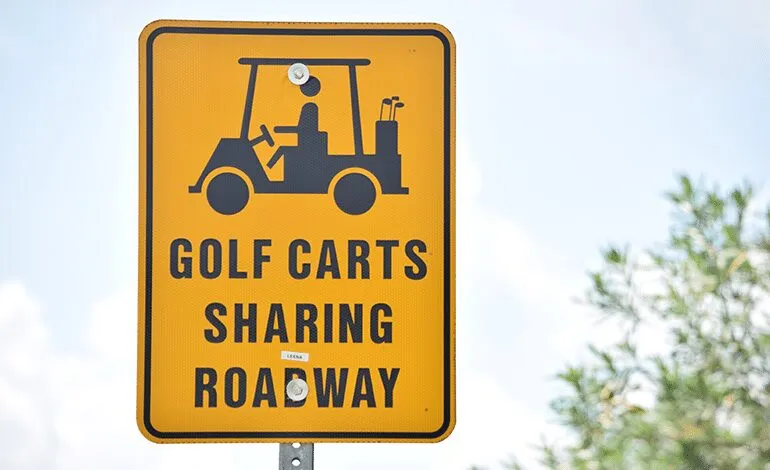
Golf carts are cheap to run and easy to park in beach towns and other small communities. They are not automatically legal on every Michigan street. A local resolution has to allow them, and MCL 257.657a still caps speed, hours and which roads you may use. That is why so many people get the rules wrong.
Here is when a cart may leave the course, what insurance does and does not cover, and who may be liable after a crash.
Do You Have a Case?HOW DOES MICHIGAN LAW DEFINE A GOLF CART?
MCL 257.657a(21) defines a golf cart as “a vehicle designed for transportation while playing the game of golf.” The No-Fault act uses the same definition and then excludes golf carts from “motor vehicle” (MCL 500.3101).
That is not a license to drive one anywhere. A city, village or township with fewer than 65,000 people (most recent federal census) may, by resolution, allow golf carts on its streets. That 65,000 cap took effect July 27, 2026 (2026 PA 73). Detroit, Grand Rapids, Warren and other large cities are still out.
A local unit may keep a free list of carts and operators. It may not charge a listing fee. A county board may veto only a township resolution, and only after a noticed hearing that finds significant environmental damage or a significant public-safety concern. Cities and villages are not subject to that county veto.
Mackinac Island is the wrong example. Motor vehicles are largely banned there, and golf carts stay on the golf courses.
A low-speed vehicle is a different class. LSVs are built to federal equipment rules, registered with the Secretary of State and treated more like cars. Do not assume a street-legal LSV and a golf cart are the same machine.
DO I NEED NO-FAULT INSURANCE TO OPERATE A GOLF CART ON THE STREET?
No. A golf cart used under 657a is not a motor vehicle for MCL 500.3101, and MCL 257.657a(20) says it need not be registered with the Secretary of State for No-Fault purposes. You do not buy PIP on the cart itself.
If a car or truck is in the crash, the injured occupant is generally treated like a pedestrian. PIP can still be owed under the priority rules (often a household auto policy first, then the striking vehicle). Medical PIP follows whatever limit that auto policy carries after the 2019 reforms.
A cart-only wreck (you vs. a tree, another cart or a pedestrian) is not a No-Fault claim. Health insurance, homeowners or other liability coverage may apply. Optional golf-cart or umbrella coverage is still worth asking an agent about.
WHAT ARE THE RULES FOR OPERATING A GOLF CART OUTSIDE A GOLF COURSE?
You need a local resolution first. Then statewide limits apply:
- Operator must be at least 16 and licensed to drive a motor vehicle
- Top speed 15 mph
- Stay off streets posted over 30 mph, except to cross
- Stay off state trunk highways except to cross, unless MDOT has authorized a local ordinance for a qualifying connector (that MDOT path is still limited to locals of 30,000 or fewer, not 65,000)
- Ride as near the right as practicable
- Use turn signals the same way a car would (MCL 257.648)
- No sidewalks built for pedestrians
- No passing between lanes of traffic (you may pass in an unoccupied lane)
- No operation from ½ hour before sunset to ½ hour after sunrise
- Helmets are not required statewide
- Police officers on duty are exempt
A city may require you to use a designated adjacent path if one exists. It may also close some 30 mph (or slower) streets to carts. Check the local resolution before you leave the driveway.
WHO IS RESPONSIBLE FOR A GOLF CART ACCIDENT?
It depends who caused the wreck:
- A negligent driver who hits the cart
- A negligent cart operator who hits a car, bike or pedestrian
- A property owner or other third party in a limited set of defect cases
Cart-only injuries usually go through health insurance and ordinary negligence. When a motor vehicle is involved, pursue PIP first, then a third-party claim if the injuries meet MCL 500.3135 (serious impairment of body function, serious permanent disfigurement or death). MCL 600.2959 bars noneconomic damages if the injured person is more than 50 percent at fault.
Michigan’s three-year personal-injury clock still applies to most private claims.
ARE GOLF CARTS REQUIRED TO HAVE SPECIFIC SAFETY EQUIPMENT?
Not automatically. Statewide 657a does not force headlights or belts. The city, village or township may require some or all of the low-speed-vehicle equipment in 657a(21), including:
- Two headlamps
- A tail lamp
- A stop lamp and a turn signal
- Red reflectors on each side toward the rear and one on the back
- A driver’s-side exterior mirror, plus a passenger-side exterior or an interior mirror
- Brakes and a parking brake
- A horn
- A windshield
- A permanent manufacturer’s ID on the frame
- Safety belts, if the local rule adopts them
- LSV-style helmet rules, if the local rule adopts them
“Registered within its jurisdiction” in that subsection means the local list, not a Secretary of State plate.
OUR MICHIGAN CAR ACCIDENT LAWYERS
If you or a loved one is hurt in a golf cart crash, we can help. These files mix local traffic rules with No-Fault priority and ordinary negligence.
Car accident law is complicated, but finding the right Michigan car accident attorney is simple.
Don’t let the legal clock run out. Fill out the brief form below or contact us for a free, no-obligation consultation.
Do You Have a Case?